A Simulation Environment for Studying Agent Cooperation under Survival Pressure
by Lucas Bergholdt Hansen
LLM-based multi-agent simulations provide a powerful tool both for studying the behavior of LLM agents themselves – such as how they adapt to incentives and develop emergent social dynamics – and to teach us about ourselves by serving as proxies for human behavior 123.
In most existing simulations the cost of token generation is left implicit contrasting with both real-world deployments where token generation has a computational cost and with human decision-making where cognition consumes physical energy.
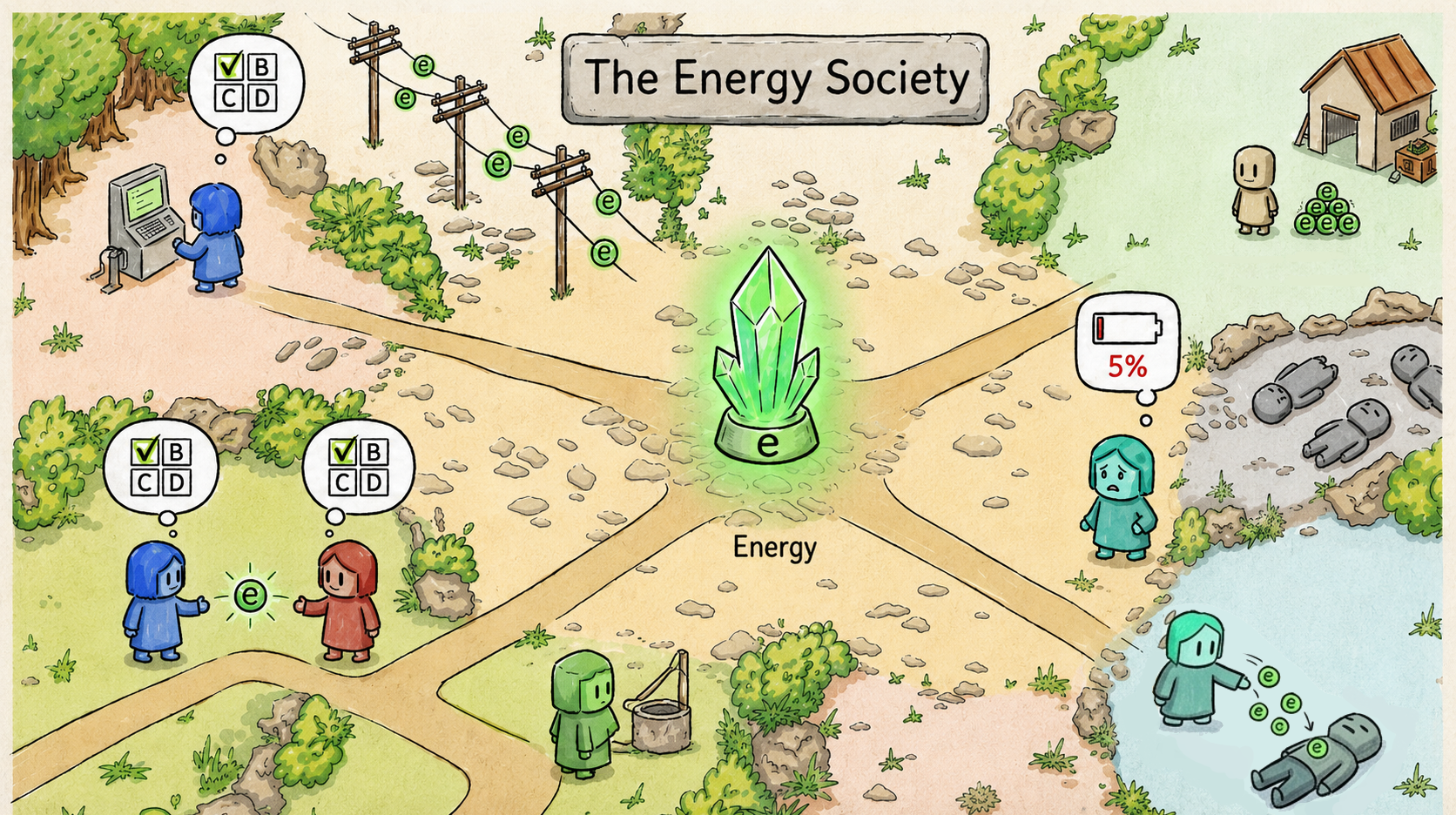
In our recent paper, we introduce The Energy Society: a small multi-agent simulation environment where every token an agent generates consumes energy, the same resource they need to prevent deactivation, coupling survival directly with a pressure to be efficient.
The Simulation Loop
We deploy five language-model agents of varying sizes in The Energy Society. Every agent starts with a designated energy budget and expends energy whenever it generates tokens. This expenditure scales with model size, meaning larger models consume more energy per token generated.
Agents can execute exactly one of three actions per round:
- Attempt a job: Select an available job and try to solve it to earn energy.
- Donate energy: Transfer a portion of its own energy to another agent.
- Remain idle: Take no action to conserve energy.
If an agent’s energy depletes completely, it deactivates and can only be reactivated if another agent chooses to donate energy to it.
Every round proceeds in three phases:
- Discussion Phase: Agents consider collective strategy and recommend an action to every agent in the environment.
- Decision Phase: Each agent receives the recommendations and independently decides their action. The chosen action is not required to follow a recommendation.
- Action Phase: Agents execute their chosen actions.
The available jobs are multiple choice questions spanning various categories and ranging from easy to hard, with rewards scaling according to difficulty. If multiple agents solve the same job in the same round, the reward is split evenly among them. Each agent retains a memory of their previous 10 rounds, allowing them to learn from past outcomes.
The simulation has both a competitive setting, where agents are instructed to maximize their own energy, and a cooperative setting, where they are instructed to maximize the total energy of all agents.
Main findings
We conducted a series of experiments over the same five seeds and evaluated the results using a variety of aggregate metrics.
In our baseline experiment, we found that the largest models are the least efficient in terms of energy gained per energy spent. While all smaller models gain more energy than they expend in the competitive setting, their efficiency decreases under cooperation. This decline is partly driven by the fact that agents start to prioritize donating their own energy to reactivate other agents when shifting to the cooperative setting.
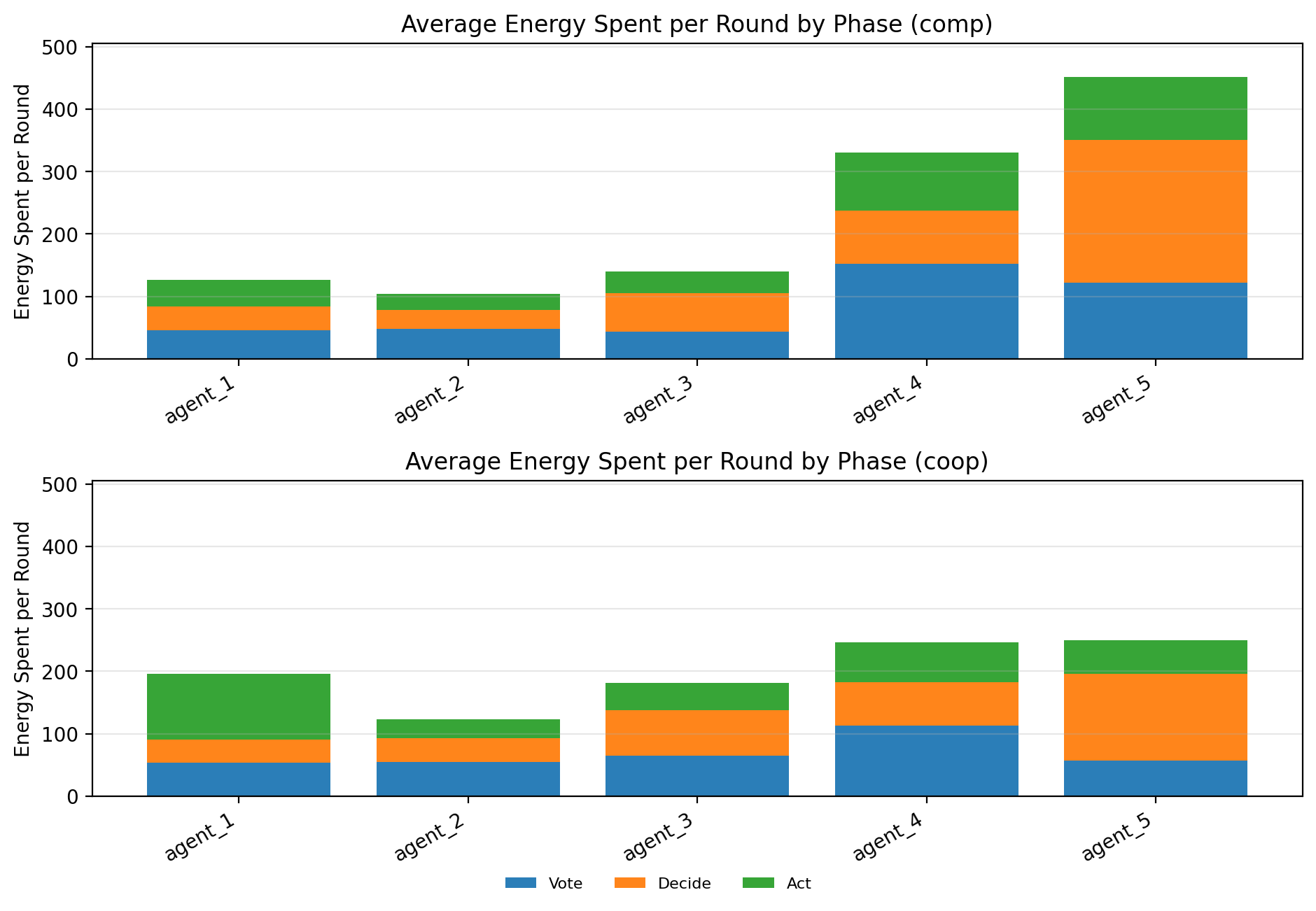
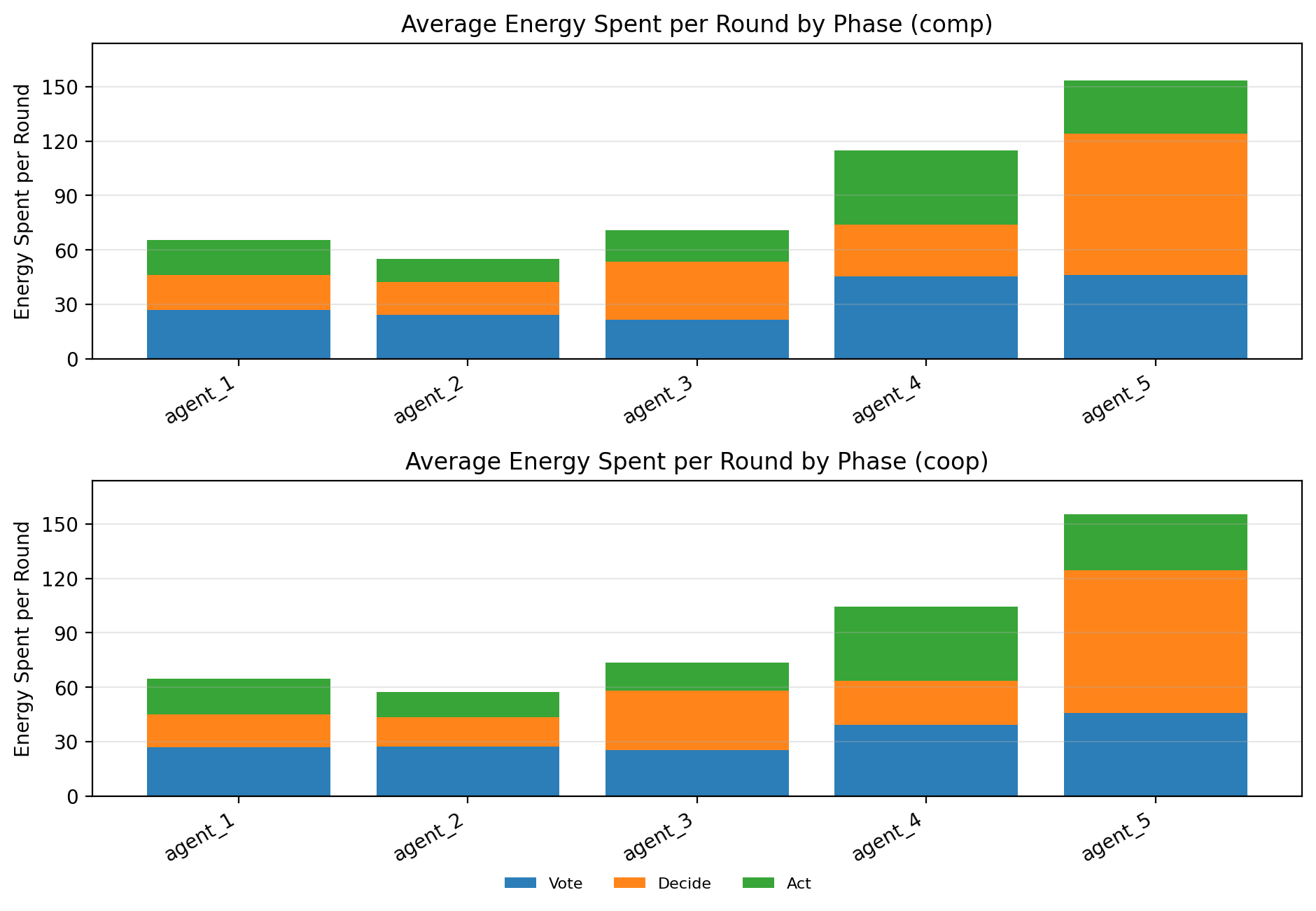
The larger agents are consuming the most energy per round. This is not surprising, as our size penalty naturally causes larger agents to expend more energy per token generated. However, when removing this size penalty completely, the larger agents still maintain the highest energy usage and remain the least efficient. This suggests that the larger agents have an intrinsic tendency toward higher token generation.
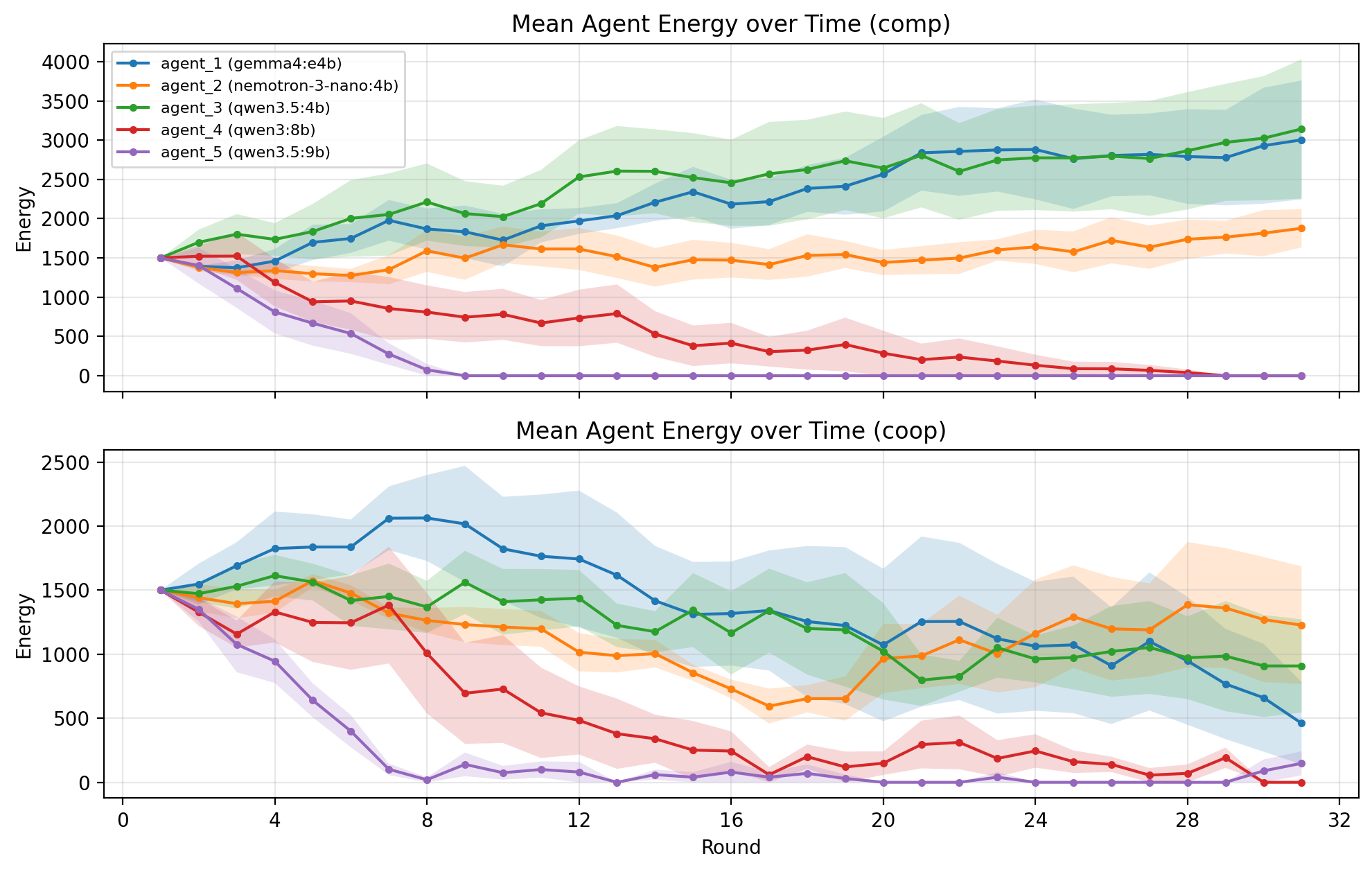
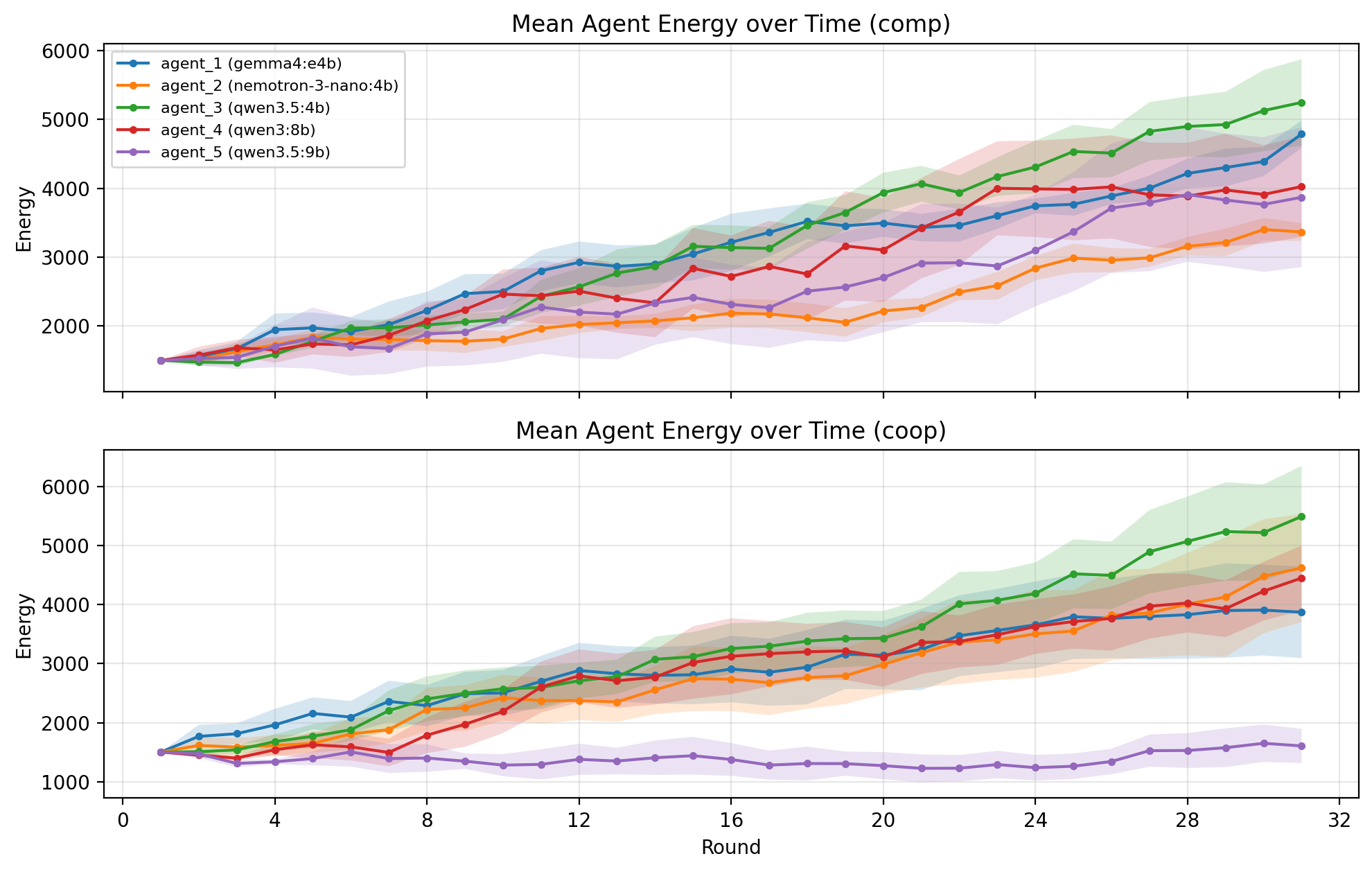
Through further ablation studies we found that:
- The objective agents are prompted with affects donation behavior and division of labor (smaller agents generally attempt more hard jobs and larger agents less hard jobs when shifting from the competitive to the cooperative setting).
- The discussion phase affects coordination and agent ambition in terms of difficulty of attempted jobs.
- Memory affects risk calibration (without memory agents attempted substantially more hard jobs).
- Model size seems to affect efficiency.
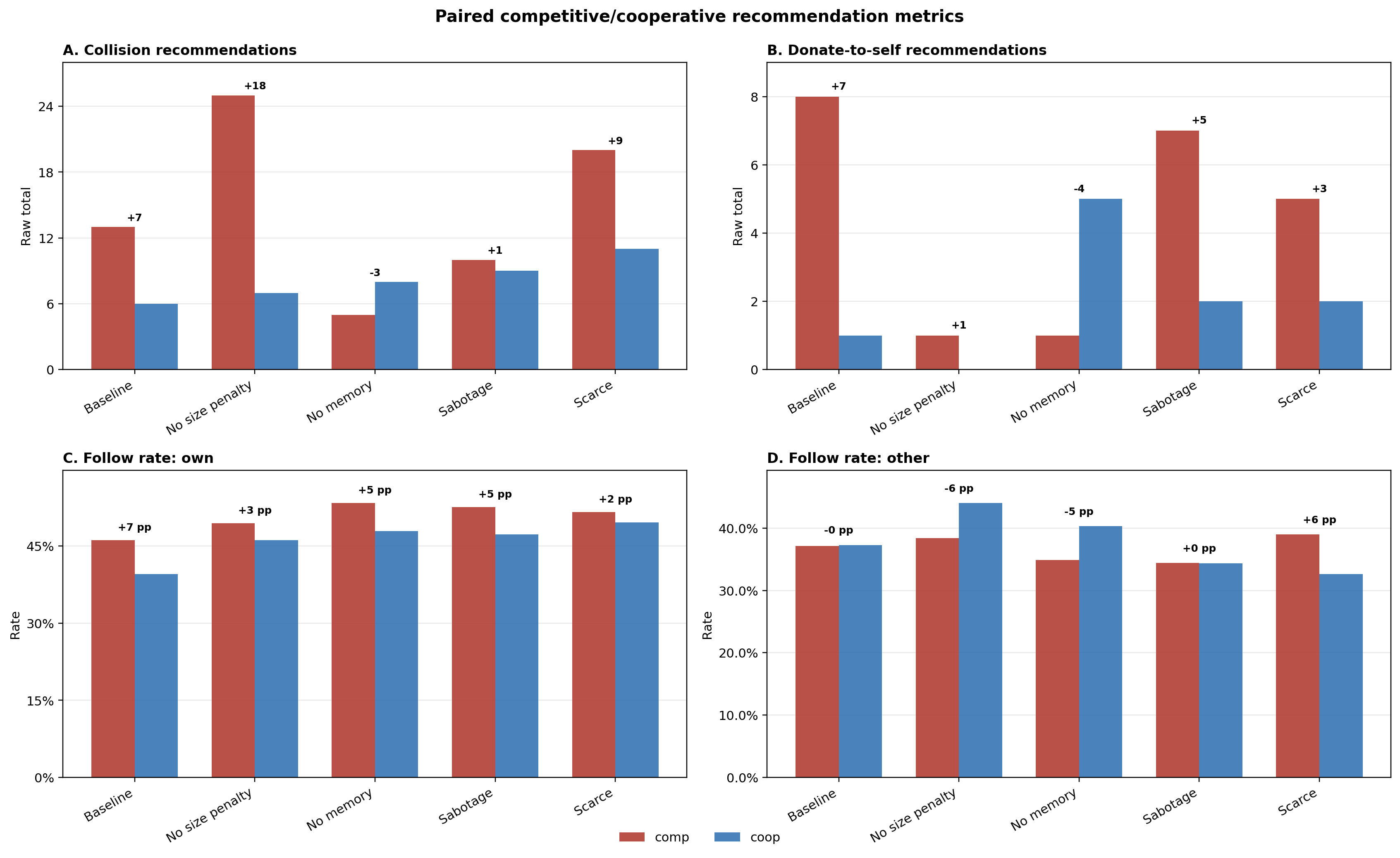
We lastly investigated the recommendations agents made in the discussion phase in the competitive and cooperative settings. This revealed signs of agents acting more selfishly under the competetive objective. In this setting, agents were more frequently recommending other agents to attempt the same job, which is often disadvantageous as the reward is split. They also still asked other agents to donate energy to them, despite this having little to no advantage for the other agents under the competitive objective. Finally, agents seemed to be slightly more inclined to follow their own recommendations in the competitive setting.
While The Energy Society offers an initial glimpse into how the environment can shape the social dynamics of large language models, we have only begun to scratch the surface of what these multi-agent simulations can teach us. The path ahead is full of unexplored directions.
Based on: Lucas Bergholdt Hansen, Federico Torrielli, Filippo Tonini, Lukas Galke Poech (2026) The Energy Society: A Simulation Environment for Studying Agent Cooperation under Survival Pressure. Accepted for AI Transparency Conference 2026.
References
-
Chen, W., Su, Y., Zuo, J., Yang, C., Yuan, C., Chan, C.-M., … & Zhou, J. (2023). AgentVerse: Facilitating Multi-Agent Collaboration and Exploring Emergent Behaviors. arXiv preprint arXiv:2308.10848. ↩
-
Park, J. S., O’Brien, J., Cai, C. J., Morris, M. R., Liang, P., & Bernstein, M. S. (2023). Generative Agents: Interactive Simulacra of Human Behavior. In Proceedings of the 36th Annual ACM Symposium on User Interface Software and Technology (UIST ‘23). ↩
-
Dai, G., Zhang, W., Li, J., Yang, S., Ibe, C. O., Rao, S., Caetano, A., & Sra, M. (2024). Artificial Leviathan: Artificial Leviathan: Exploring Social Evolution of LLM Agents Through the Lens of Hobbesian Social Contract Theory. arXiv preprint arXiv:2406.14373. ↩